paperbasket made of paper

Tuesday, September 27, 2011

Stumbled on this very smart object by Studio Verissimo, the firm of portuguese designers Cláudio Cardoso and Telma Veríssimo.

photograph by ricardo faria, 
used with the kind permission of Studio Verissimo


It's a paper basket woven from pages of newspaper.
Seems to be doing just what a paper basket should be doing: stand up straight, hold paper!
Most likely disposable and compostable at the end of its life.
What more does the people want, eh?

UPDATE
Japanese brand MUJI sells a similar paper basket made from pages of phonebooks, handwoven in the Philippines.


- I say: I want a how-to guide for weaving it myself - people could start making those at every street corner
- my better half says: 'why are we producing the big wasteful phone books in the first place?' - he has a point.


the haves and the have-Nots

Wednesday, August 24, 2011

Kenya-born, England-raised photographer James Mollison has created a series called Where Children Sleep: 'stories of diverse children around the world, told through portraits and pictures of their bedrooms.'

I find this work thought-provoking from many angles - social, political, etc., and in the context of this blog, a good representation of clashes between 'material cultures'. Not so much linked to the country (a lot of the extremes shown here probably have a replication everywhere you go), but rather linked to revenues, customs, and spending patterns.

Here are 2 bedroom photographs from the series, with the personal belongings of the children laid out in the space:

The bedroom of Kaya, a 4-year old girl in Tokyo, Japan


The bedroom of Ahkohxet, an 8-year old boy in the Brazilian part of the Amazon Rainforest.


- the first photo fascinates me because
1) the accumulation of objects in the room seems to overcome the life that can take place within it - more museum than bedroom, at least from that angle
2) light, furniture/flooring, and most of these objects are artificial (neon light, particle board, fake wood, hard & soft plastics, artificial fabrics & fur)
3) through sheer number, they overfulfill a need (hundreds of toys vs. the basic need to play / 20+ heavily decorated outfits vs. the basic need to be dressed).

- the second photo fascinates me because
1) the presence of raw materials is almost brutal (earth floor, clay & wood walls, reeds on the roof, etc.) + natural light
2) it seems we could trace each object back to a basic need (a backpack to carry things, a pair of shorts and underwears, blankets to be warm, a platform to sleep on, a rope to hold clothes...)

I wonder about the kind of society that creates the former - I feel that I belong to it, and that photograph is simply one of its most radical illustrations - where 'comfort' is created through the massive production of heavily designed items, relying heavily on the petro-chemical industry, taking up space and blurring our vision of necessary vs. superfluous. What kind of action/behavior could turn it around?

Even if I can never tell whether Ahkohxet is happier or not than Kaya, poorer or not in all the possible meanings of 'poverty', burdened by the same petrochemical industry but in more complex ways, I am attracted to the idea that anybody, regardless of their wealth, could make the choice of owning very few, but useful and therefore meaningful, things.

Thoughts from my friend Scott while this article was still in the works :'In addition to the obvious conclusions about material obsessions and waste, another way of looking at these is to ask "who has more?" in a broader context. Maybe the roles are reversed? Material possessions can isolate people. It would be interesting to see what each child's "outside" looks like, and what they experience in a typical day with family and neighbors.'

And from my friend Nick, who lives in the US: 'Ahkohxet's room looks like my bedroom when I was his age - drab drab drab :)'


Photographs published with the kind permission of James Mollison.
For those interested, the book Where Children Sleep is currently sold out, but will be reprinted later this year by Chris Boot.

object peripheries

Saturday, August 20, 2011

Here is a diagram I want to keep refining as I go.


It's a mapping of belonging according to necessity, with the most necessary items in the innermost circle, and the less-necessary ones on the outer peripheries.

Basically, a diagram which would help me organize what I own (and pack my luggage much faster for sure).

For the moment it's slightly gender biased - or maybe not, you tell me.

no-waste ice-cream

Thursday, August 11, 2011

Today, a micro-subject again.
(even though minuscule in scale, micro-subject can demonstrate great principles).

We'll be comparing, once more, two ways to do the same thing, with radically different conceptual qualities and environmental impacts: the edible ice-cream cone and the disposable ice-cream cup. A simple choice we make in a split second at the ice-cream store - ['we' the spoiled-enough to have and go to such places - if you're reading me from rural Burkina-Faso, this entry and probably the entirety of this blog is indecent, but maybe that's the reason I am writing it too].

So yes, when asked 'cone or cup', we choose what we're in the mood for:

Option A: THE CUP

Paper cups at Toscanini's Ice Cream, Cambridge, MA - original photo by surlygirl

- it's either paper coated with plastic or wax (i.e. difficult to compost) / or polystyrene foam / or a plastic cup.
- often printed with advertising (an extra industrial step)
- inevitably creates the need for a plastic spoon or several
- quite dumb structurally (holds ice-cream by stopping it with walls)
- after consumption, has to be discarded, overflows the garbage at the JP Licks, fills the landfill, etc.
I am no specialist in CO2 emissions or manufacturing, but cups seem quite energy-intensive with a relatively ugly, polluting ending.

So take a look at the marvellous alternative that sits next to them on the counter:


Option B: THE CONE

A wafer cone - original photo by TheCulinaryGeek

After doing a bit of fascinating research on cones (waffle, sugar, wafer, etc.) - the winner in my view is, hands down, the molded wafer cone.
- made of a mix of flour, starch, sugar, fat, water, shortening and baking powder
- is the result of one process which apparently creates little waste
- is an extra light structure whose shape has only been determined by its ability to carry the weight and droppings of ice-cream - a great piece of engineering (sugar and waffle cones, although quite good themselves, do not reach the same level of refinement when it comes to design).

'Cone designers refine the waffle pattern and other shape characteristics and make trial batches to find the best design that releases from the mold without burning, breaking, or creating weak spots that won't hold ice cream or will break when the scoop is applied. The molded cone has a lip around the top that keeps drips contained inside the cone. The row of teeth helps firmly seat the scoop of ice cream and provides added strength where the upper lip of the cone meets the cylindrical base.'
(from How Ice Cream Cone is Made, by Gillian S. Holmes)

Ribs inside a wafer cone - original photo by seanfraga

- can be eaten entirely by a human being after the ice-cream is done with.

There. Isn't this a brilliant example of good design, providing just what is needed, while having a seemingly benign environmental impact? Packaging turned into food, so old and so essential as an idea.


So, next time you have the choice, do the right thing:
be a cone-(wo)man.


Note 1: I recommend taking a peak at conewafer.com (weird and great).
Note 2: Cones appear to me to be a lesser evil, however they'll reach perfection only when we can trace all their ingredients to safe and sound production methods. Hopefully this is not wishful thinking.
Note 3: We don't need to eat ice-cream.

mattresses

Monday, August 8, 2011

After my move I had to get rid of one western-style mattress.

Aside from being one of the most difficult things to transport - large, heavy to carry and you never know where to grab them -, trying recycling one and you're in for a treat:

1. mattress manufacturers want to have absolutely no business taking them back for the raw materials (I called)
2. most people are paranoid about bed bugs (understandable)
3. most people are uncomfortable with using another person's old mattress (probably the most personal piece of 'furniture')
4. it is illegal to sell a used mattress in the state I live in (bye bye Craigslist)
5. places such as the Salvation Army or Goodwill very rarely accept them
6. shelters for the homeless welcome mainly single / double size, but not bigger

Therefore, a very likely ending is this one:


So the question is: WHY?
Why do we keep making > selling > using > discarding such inconvenient objects, with a lifecycle which doesn't loop?

Ok, mattresses are, technically, among the awesomest inventions to put on bed frames, and do whatever you use a mattress for. Which makes them very tricky to renounce to.

2 ideas I've been mulling over recently:
- BYE BYE KING AND QUEEN!
Replace the solid king and queen sizes with two halves that can be strapped together with a clever device. That way when you move, you only transport 50% of that inconvenience at the time. Also, the two halves of a couple could each have the firmness they enjoy - say goodbye to compromise!(and couples therapy bills)
- HELLO JAPANESE FUTON:
'the traditional style of Japanese bedding consisting of padded mattresses and quilts pliable enough to be folded and stored away'. Heavenly for transporting.

Folded shikibutons and kakebutons - photo by renfield

From personal experience - sleeping for three months on a futon on a wooden floor - the comfort level is pretty high. Not as bouncy as a spring mattress of course, but cushy enough. You do feel the straightness of the floor below you, but nicely buffered, and maybe even good for your back.

Futons in action - photo by Debs

Sleep tight.


the right cotton swab

Sunday, August 7, 2011

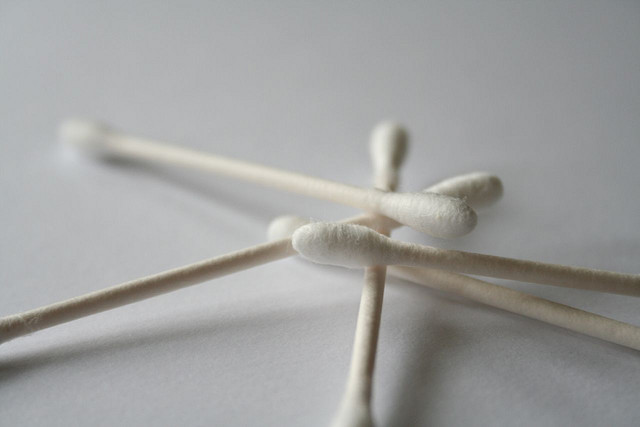
In my country, most Q-tips come with a plastic stick - white or colored, opaque or translucent.

Q-tips with PVC stick

In the US I discovered an amazing invention: the paper stick.
[amusing historical fact: originally made of wood in the twenties, the sticks became paper in 1958, churned out by british machines that had been producing them for candies]

It seems so beautiful and minimal: just structural enough to be used once, fully compostable, no artificial colors, some even unbleached. Just fulfilling the need it was created for, no more, no less.


Paper stick Q-tips - photograph by DragonWoman


Made me suddenly realize the material overkill ('unbreakable'?! - it's a Q-tip!!) and polluting consequences of the former.

A huge environmental gap between 2 almost-identical objects, isn't it?

Buying nothing new

Thursday, July 28, 2011

Saw a TED talk called 'Wearing Nothing New', by Jessi Arrington.


The talk itself was nicely punchy, although a bit predictable - about finding all necessary items of clothing second-hand.

One problem is that she appears to advocate for saving resources, but doesn't acknowledge an obvious contradiction: fashionistas shop for way more clothes than they need - quite a wasteful starting point for a tree-hugger. Ok, she gives them back to the store in the end - and I like the statement 'It's OK to let go', to a certain extent. But then, you'd have to be pretty loaded on the long term to buy new clothes for a week, then give them all up and start again.

However, if you disregard the bobo incoherence, the idea contained in the title is pretty great.

Often I wonder if we could achieve this and for how long: living in a society where all available 'things' are visible / tradeable, and our first move would be to buy objects already 'in the world', instead of getting everything new.

Why do we need and end up getting NEW stuff?
Undoubtedly there is something about our psychological approach to self, wanting to be the first to use/wear something, associating NEW with a certain idea of CLEAN, good old-fashioned social pride to be able to afford NEW, etc.
But also, it still seems easier to buy NEW than USED, doesn't it - just compare the IKEA online catalog and the sexy Craigslist of results if you type 'wardrobe'.

More on this later.

Material - Immaterial

Monday, July 4, 2011

Ok, maybe I don't want to talk only about objects.
It's more about: how do you lead your life while using just what you really need. Things, food, energy, time.
So I am changing the subtitle: 'a blog about material possessions' into 'what exactly do we need'.

It's a bit tricky to be starting this blog because I have a backlog of thoughts to write, but need to feel I've defined the terms of the discussion beforehand.

So yes, this is also about immaterial things, and at all scales too. What do I really need as a person, to function? What does a building really need to function? What does a city really need to function? etc.

The subject is of interest to me because doing a bit of sorting would be soothing. There is so much stuff, everywhere. Matter, media, choice until you can't take it anymore. Stuff keeps coming, and we end up having to fend it off. No, I don't need a plastic bag. No, I don't need ten little pouches of ketchup with my fries. No, I don't want to receive your special offers.
It's tiring.
Being happy with just the necessary shouldn't be so hard.

Wasting ressources shouldn't be an Opt-Out behavior.
And we should pay something in return for the extras.

Moving

Sunday, July 3, 2011

If, like me, you live in a western(ized) society, leading a nomadic life (i.e. moves every 1,2,3 years) yet having a sedentary lifestyle (i.e. owning a queen size bed frame), moving is an extremely stressful time in your life.

It's probably the only time when you are forced to really face how much s... you have.

I recently moved for the 13th time.

Every time I think to myself: next time you will be lighter.
Slowly getting there, but even when being uber-careful about the things I agree to own, every time I am surprised by the amount.

This is my dream: Travel lightly. Live lightly. Bring with yourself only the necessary.